



More than two and a half months after 84-year-old Nancy Guthrie disappeared from her home in Arizona, the case remains unsolved.
It has drawn national attention, in part, because of her daughter Savannah Guthrie’s prominent role on NBC’s Today, yet there have been no arrests and few confirmed leads, despite growing pressure on local authorities and ongoing public appeals from the family.
That dynamic may now be shifting, as authorities have transferred DNA evidence recovered from the home – including a rootless hair sample believed not to belong to Guthrie or her immediate family – to the FBI Laboratory for advanced forensic analysis.
Former FBI agent Greg Rogers highlighted the significance of the move, saying:
“The FBI lab is the best in the country… A high-priority case like this is prioritized, and results can come back in a matter of days.”

Rogers noted the lab’s access to nuclear DNA, Y-chromosome, and mitochondrial DNA testing, alongside the CODIS database and international coordination – a factor seen as especially important given Tucson’s proximity to the U.S.-Mexico border.
The science behind the renewed hope lies in recent advances in whole genome sequencing, which allow investigators to extract usable DNA profiles from degraded hair shafts that lack the follicle traditionally required for nuclear DNA analysis.
Genetic genealogist CeCe Moore underscored the significance of that shift, saying:
“I’ve been really hoping that maybe they had some hair to work with. Because of the more recent advancements in the field, hair actually can make the case solvable.”

The same approach played a key role in the Gilgo Beach investigation, where rootless hairs found on victims underwent cutting-edge analysis and were ultimately used to support the case against Rex Heuermann.
An expert familiar with the Gilgo Beach serial killings investigation said:
“What’s happening here mirrors the shift we saw in the Heuermann case – evidence that would have been dismissed ten years ago is now front and center.
“A rootless hair used to be almost a dead end. Now, it can be the thread that unravels everything.”
In that case, the use of advanced DNA testing marked a turning point, with a judge allowing the evidence despite defense challenges over accuracy – a decision that signaled growing confidence in the method’s reliability.
Experts say the parallels are difficult to ignore.
“The Gilgo case showed that even heavily degraded hair can now produce meaningful genetic information, whether that’s a direct match or a genealogical lead.
“In a case like Guthrie’s, it doesn’t have to identify the suspect outright – it just has to narrow the field enough to give investigators direction.”
The broader implications extend beyond a single case, as law enforcement increasingly turns to techniques once considered experimental to solve both cold cases and active investigations.
For the Guthrie family, the development represents a rare moment of forward movement after weeks of uncertainty, public scrutiny, and mounting frustration with the investigation’s pace.
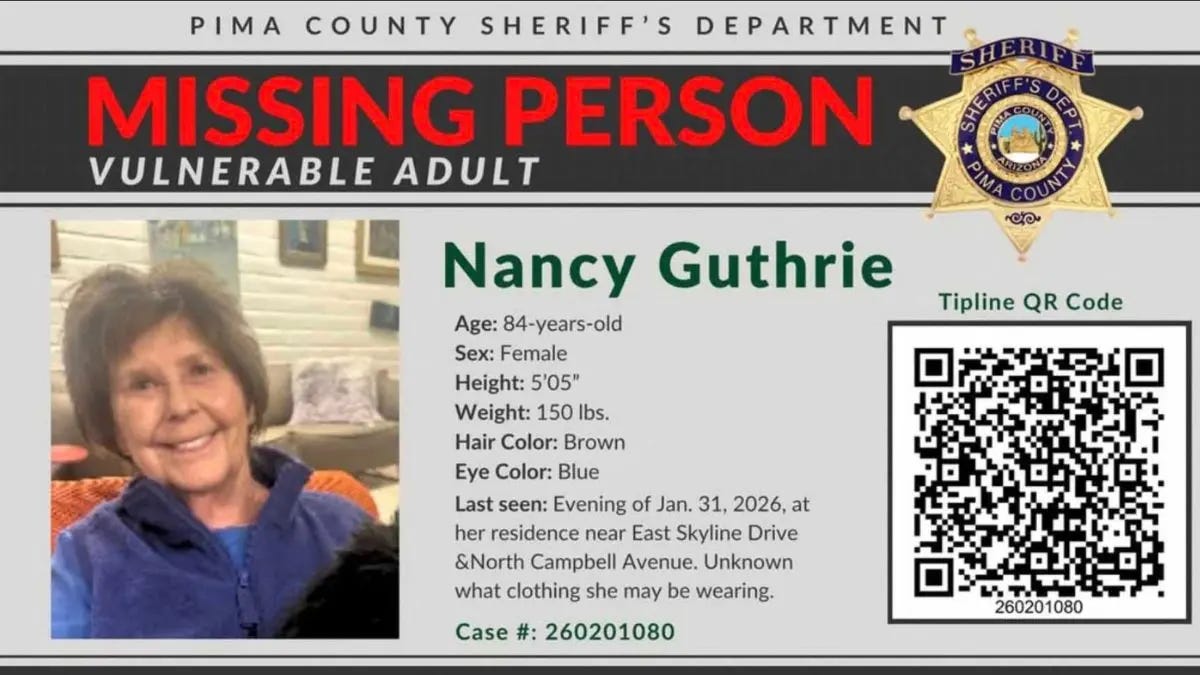
Authorities have reiterated their commitment to the case, with federal involvement now placing additional resources behind the effort, while the public continues to follow closely through vigils, online discussions, and ongoing media coverage.
Yet even with the technological advances, experts caution that results are not guaranteed, and that any DNA recovered could belong to an innocent party rather than a suspect.
Still, the potential remains significant.
As one expert put it:
“In the past, this kind of evidence might have sat in storage indefinitely.
“Now, it has the potential to generate leads, eliminate possibilities, and – in the best case – identify exactly who was in that house.”

For now, the investigation remains open, with no named suspects and no confirmed theory of what happened that night.
But with a single strand of hair now under analysis at one of the world’s most advanced forensic laboratories, the case may be closer than ever to its first real break.
And for Nancy Guthrie’s family, that possibility – however uncertain – is something they have been waiting for since the night she disappeared.